Anthems
In the classic Greek coming of age novel “Leonis’ Diary” (Το ημερολόγιο του Λεωνή), Giorgos Theotokas paints a cross-generational picture of Greeks of pre-First World War Constantinople, encouraged by their compatriots success in the Balkan Wars, taking the final step in totally rejecting their status as Ottoman subjects and their place in the racially and religiously stratified Ottoman Empire.
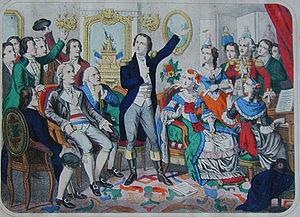
Rouget de Lisle, the composer of the French national anthem La Marseillaise, sings it for the first time. The anthem is the second-earliest to be adopted by a state, in 1795
Among the young Leonis’ classmates, this is manifested by one of them, Menios, refusing to learn Turkish or participate in Turkish class, despite this affecting his grades on his report card. In another vivid scene, Leonis’ classmates, in an act of defiance against their overloads and by way of emancipation through the assertion of their own political and ethnic identity, refuse to cheer and chant pro-Ottoman and German slogans, on the occasion of the visit of the German Kaiser to the City. By rejecting the paraphernalia of propaganda, Leonis’ classmates signified that they no longer felt bound by or part of the State that claimed a proprietary hold over them, while Leonis, more cautious, mused that the Greek nation was one that was “newly impoverished.”
States employ a multitude of flags and symbols designed to invoke a feeling of unity that will underpin and reinforce its guiding ideologies. One of the most paramount of these, is the national anthem, a patriotic musical composition that evokes and eulogizes the history, traditions and struggles of a people, recognized or instituted by a nation’s government as its official song, or by convention, through the use of the people. Thus, the «Υπερμάχω Στρατηγώ,» an Orthodox Hymn to the Theotokos as Defender General composed during Byzantine times, as far back as 676, in thanksgiving for her miraculous deliverance of the people of Constantinople from siege has been chanted by Greeks in times of delivery from evil ever since and has widely been held to be an unofficial anthem of the Greek people.
Despite this most antique pedigree, national anthems are relatively recent inventions, rising to prominence in post-Bonapartist Europe in the nineteenth century, though some others predate this period, in origin, if not in institution, such as the Wilhelmus, written in 1568 during the Dutch Revolt but only officially adopted in 1932. Spain’s national anthem, the Royal March, dates from 1770 and was adopted in 1780, while the Marseillaise, which in turn inspired the “Thourios,” Rigas Pheraios’ rousing call to action, was adopted in 1795 in France. Serbia, interestingly enough, was the first Balkan nation to have a national anthem, in 1804.
Despite the popularity of “Thourios,” its universalist and inclusionary sentiments, calling upon all oppressed Balkan Christians of diverse nationalities to unite, could not render it an appropriate propaganda vehicle for an ethnically exclusionist nation state. As a result, Dionysis Solomos’ 1823 Hymn to Liberty was adopted in 1865, as Greece’s national anthem, all one hundred and fifty eight stanzas of it, making it the longest national anthem in the world. Funnily enough, there exist two choral versions of the anthem, both written by Corfiot operatic composer Nikolaos Mantzaros, a longer and a shorter, both of which are relatively uninspiring and serve to render trivial or mind-numbingly banal, the rousing and moving sentiments of Solomos’ masterpiece.
Greece’s founding myth, as conveniently contained within its national anthem is that of an armed struggle by a renascent people against tyranny, in defence of liberty. Australia’s national anthem on the other hand, written in 1878 but only adopted in 1984, is an adaptation of a paean, penned by Peter McCormick, celebrating the bounty of Australia and the courage of the British who established themselves there, and inviting further colonization by “loyal sons”. In its current form, it still celebrates the bounty of Australia, while letting people who have come “across the seas” know that “we’ve boundless plains to share.” Considering successive governments’ immigration policies, perhaps a footnote should be added to this stanza, noting that the verse does not apply to boat people. Either that, or an amendment such as “for those who’ve come across the seas, in an above board and legal manner pursuant to the Migration Amendment (Excision from Migration Zone) Act 2001,” is in order. This notwithstanding, it is evident from the lyrics, that Australia’s founding myth is that it is a land of opportunity, in which everyone may have a share.
Both the lyrics and the melody of the anthem have been criticized as being dull and unendearing to the Australian people. In 2011, for example, National Party Senator Sandy Macdonald opined that Advance Australia Fair is so boring that the nation risks singing itself to sleep with boring music and words impossible to understand. One person however, who does not agree, is our very own Victorian multicultural minister, Nicholas Kotsiras, who believes that schoolchildren should sing the national anthem once a week as part of an “Australian education” program which he says will help combat racism. According to the minister, singing the anthem would not be divisive or ostracise children from migrant families. Quite the contrary, it would according to his view, be instrumental in keeping our cultural identity but also uniting us as Victorians, as Australians.” As such, the signing of the anthem is designed to make children from different backgrounds feel like they are welcome and that in turn also prevents extremism from taking hold.
The minister should be applauded for his concern. In a country that openly accepts people of all walks of life and religious persuasion, there is always a risk that members of society, who are limited as to their ability to integrate owing to economic, linguistic or religious factors will feel increasingly isolated and ghettoized as a result. The ensuing frustration could further inhibit their successful integration into what is a remarkably tolerant and egalitarian society and limit their ability to espouse or pay lip service to these values. The recent objection by a Muslim family to an application by a Middle Eastern Christian church to construct a place of worship on land it owns in the western suburbs, on the basis that it did not want its “children growing up near a church, as this is offensive,” is a case in point. All Australian children need to know that they have a stake in their country, just as all Australian children need to respect and cherish their counterparts of diverse backgrounds. Tolerance, understanding and celebration of diversity are values that must be taught, if they are to be respected and espoused.
Unlike other anthems, which focus on violence, racial superiority and culturally or racially exclusivist ideals, the Australian national anthem provides a blank canvas of opportunity for all to share. It prescribes and imposes no values other than self-respect, nor does it demand that non-Anglo-Celtic Australians divest themselves of their cultural and linguistic heritage. Instead, it embraces these and the minister should thus not be pilloried for his attempts to utilize it in order to foster a sense of community among schoolchildren.
In a post-nationalistic Western world, we may be forgiven for being smug about the need for outdated national anthems and other banal nationalistic paraphernalia. However, various instances of outward rejection of Australian values of tolerance and mutual respect by isolated individuals and communities should not be overlooked, and steps taken to address these, not by denigrating them but instead, by causing them to focus on what unites us, rather than what divides us. Though seemingly trivial, Minister Kotsiras’ approach is a step in the right direction. And if we are to change our anthem, let’s set it to the stirring triumphal march of Verdi’s Aida. It worked for Egypt under King Faruk and is way cool.